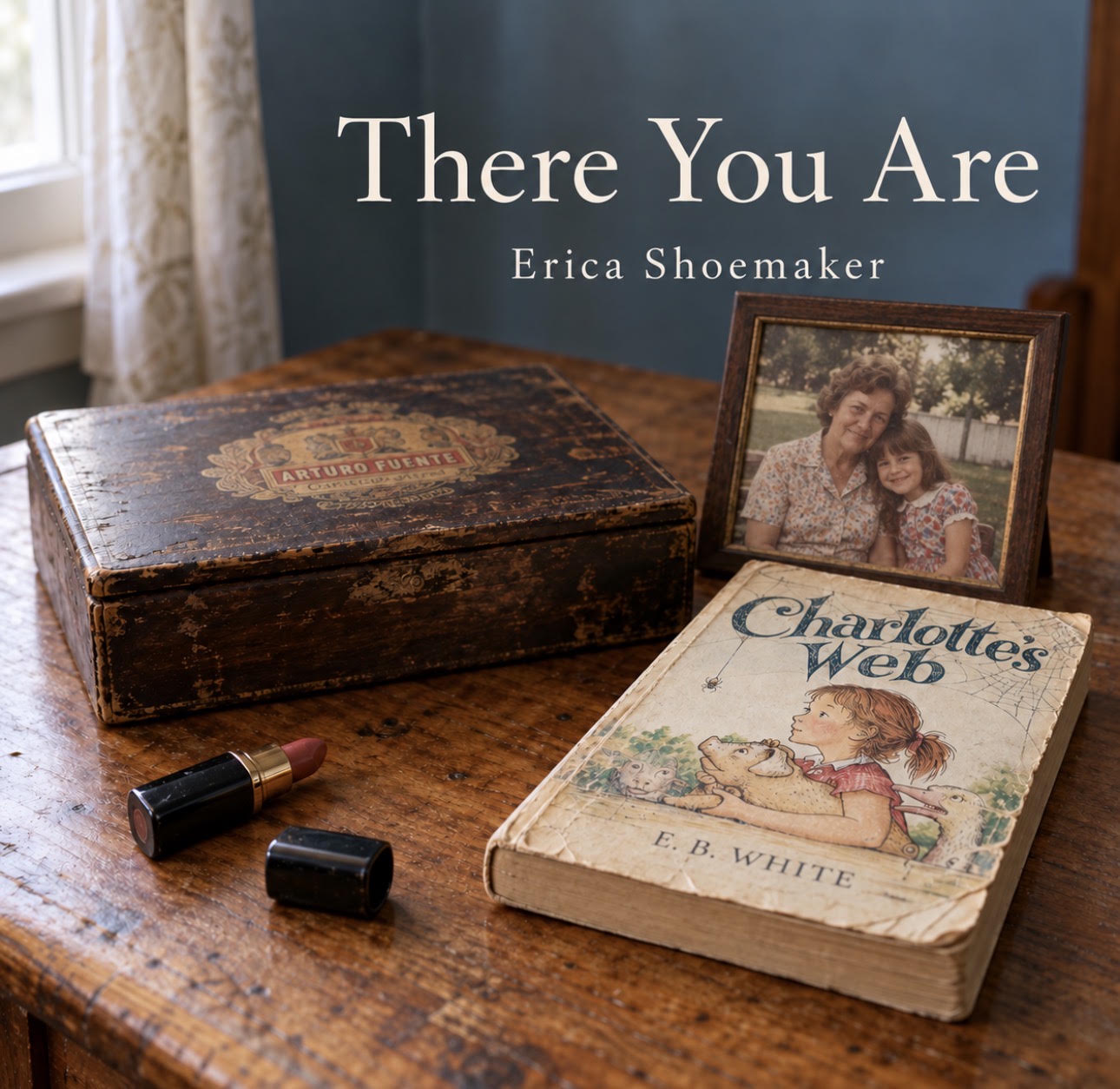
By Erica Shoemaker
By the time Rebecca arrived at memory care on Sunday afternoon, her grandmother was sitting in her usual chair beside the window, wearing one slipper and looking mildly annoyed about it.
“Well, this won’t do,” Rebecca said, setting her bag on the dresser.
The woman in the chair looked up at her politely.
“Your shoe situation, Dot. One shoe off, one shoe on,” Rebecca said, chuckling.
“Diddle, diddle, dumplin, my son John,” Dot finished.
Rebecca smiled at her grandmother, whose name was Dorothy, although Rebecca had called her Dot for as long as she could remember. Dot looked down at her feet as though she had just noticed the problem herself. Rebecca found the missing slipper underneath the bed and knelt to put it on her, then pulled a brush from the drawer, along with the small makeup bag she kept in Dot’s room.
“Hair or lips first?” Rebecca asked.
Dot studied her. “Do I know you?”
It shouldn’t have hurt anymore, but it did. “I’m Becca,” Rebecca said.
Dot continued to study her face, searching for something that wasn’t there. “You’re a nice lady.”
“Well, thank God for that. I’d hate to think I’ve been coming here every week and annoying you for nothing,” Rebecca said.
That earned her the smallest smile and a little twinkle in her eye. Rebecca brushed Dot’s thin white hair and fixed it the way she had always worn it, then twisted up the tube of lipstick and carefully added color to her grandmother’s lips.
Dot had never been particularly fancy. She had spent most of her life digging in gardens, cooking meals, raising children who technically weren’t hers to raise, and doing whatever needed to be done without making much fuss about it, but she did not leave the house without lipstick. Rebecca remembered chastising her playfully once. “You’re just going to the mailbox, Dot!”
“And?” Dot had replied wryly.
“It’s the mailbox,” Rebecca had said.
“And the mailman has eyes,” Dot had shot back with a little head toss.
That was Dot. Rebecca capped the lipstick and held up the mirror. “There. Now you can receive visitors.”
Dot smiled at her reflection. “Pretty.”
“You always were,” Rebecca told her.
Rebecca put the makeup away, then reached for the battered copy of Charlotte’s Web on the nightstand. Dot had read it to her so many times as a child, and Rebecca still hoped the familiar story might bring back a glimmer of recognition. She had read it to Dot so often over the past year that the nurses probably knew it by heart. Sometimes Dot listened, sometimes she fell asleep, and sometimes she interrupted every few minutes with a question that had nothing to do with the story. Once in a while, Rebecca could almost see the woman who had first read those same pages to her more than forty years earlier.
Back then, Rebecca had lived with Dot and Grandpa Bob in the old house in Millbrook, along with a mother who was there until she wasn’t. Melanie could be wonderful, full of affection and plans for things they would do together, but then Rebecca would wake up one morning and find her gone again. Sometimes she disappeared for days or weeks. As a child, Rebecca had thought her mother was dreamy and restless, someone who never quite wanted to grow up. Looking back, she wondered whether Melanie had been struggling with a mental illness she hadn’t understood. She knew her mother had loved her, even when she couldn’t be the parent Rebecca needed. Dot had filled that space.
Dot never made promises about when Melanie might come home. She packed the lunches, signed school papers, sat through parent-teacher conferences, and knew which teacher Rebecca hated and which boy she liked. Grandpa Bob taught her to bait a hook and slipped her the empty wooden cigar boxes that became treasure chests for whatever Rebecca brought home from her walks with Dot’s mutt Jack. Whatever her mother was doing, Dot was there. Rebecca could count on that.
Melanie had called one night wanting someone to come get her. Rebecca would later understand those calls as the times when her mother could no longer manage on her own and needed help. Before Dot and Grandpa could reach her, another call came: a car had struck her. After that, whatever technical distinctions existed between grandmother and mother disappeared completely. Dot was her home, and so was Grandpa Bob.
Now Grandpa had been gone for years, and Dot was disappearing one memory at a time. Life could be a real asshole sometimes.
* * *
Rebecca visited every Sunday to do Dot’s hair, put on her lipstick, read to her, or play music. When the weather cooperated, she pushed her outside for a walk. Some Sundays were better than others. Once, when Rebecca played Kenny Rogers, Dot sang three entire lines before forgetting what she was doing. Another afternoon, “Boogie Woogie Bugle Boy” played through Rebecca’s phone, and Dot’s fingers started tapping against the arm of her chair.
Rebecca laughed. “Oh, no. I know that look.”
Dot looked at her suspiciously.
“You used to make me dance to this in the kitchen,” Rebecca told her.
“I did not,” Dot replied.
“You absolutely did,” Rebecca said.
“I don’t dance,” Dot insisted.
“You did then,” Rebecca said, laughing.
Dot shook her head, but her foot was tapping and her smile held a hint of mischief. For a few seconds, Rebecca could see them both in that old kitchen, Dot younger and the two of them pretending to be the Andrews Sisters, singing into wooden spoons and attempting synchronized steps across the linoleum. They never could agree on which one of them was supposed to be the third sister. Then the song ended and the moment went with it. That was how Alzheimer’s worked now. It gave things back just long enough for Rebecca to understand exactly what had been taken.
* * *
By spring, Dot slept more than she was awake. The nurses told Rebecca gently that it wouldn’t be long, and she came more often then. One afternoon she sat beside Dot’s bed reading, although she had no idea whether Dot could hear her. After a while, she stopped and simply held her grandmother’s hand.
“You know, Dot, after all these years, you’d think I’d quit crying over a spider,” Rebecca said.
Dot didn’t respond. Rebecca rubbed her thumb over the back of Dot’s hand, feeling each knuckle beneath the thin skin, then used her phone to take a picture of their hands together.
“You can go if you need to, Dot,” Rebecca whispered, tears welling in her eyes. Her throat tightened as she added, “I’ll be okay.” That was a lie, and both of them probably knew it.
Rebecca sat there a while longer, talking about her daughters, Carly and Marley, about work, and about nothing. Before she left, she fixed Dot’s blanket, leaned over, and kissed her forehead.
“I love you. I’ll see you tomorrow,” Rebecca said.
She had nearly reached the door when she heard Dot’s weak voice.
“Becca?”
Rebecca stopped and turned around. Dot’s eyes were open and focused, and she was looking at her with an expression Rebecca hadn’t seen in months.
“There you are,” Dot said.
Rebecca walked back to the bed, laughing through the tears. “Here I am.”
Dot frowned a little. “You look tired.”
That made Rebecca laugh for real. “Thanks a lot, Dot.”
“You always did run yourself ragged,” Dot said.
Rebecca took her hand. For one impossible minute, her grandmother was there, the Dot she knew, rather than the confused woman who thought Rebecca was just a nice lady or sometimes mistook her for her mother. Rebecca wanted to ask a thousand questions, tell her everything, and hold on to the moment hard enough that it couldn’t disappear. Instead, she said, “I love you.”
Dot squeezed her hand. “I love you, too.”
Her eyes closed again.
“Dot?” Rebecca whispered.
Dot didn’t answer. When the nurses called the following morning, they told Rebecca she had passed away peacefully. Rebecca had been mourning Dot for a long time, and still the tears rolled down her cheeks as a sob broke from her chest.
* * *
Three nights after Dot died, Rebecca dreamed about her. Dot wasn’t old, but she had her signature color on her lips. That was the first thing Rebecca noticed. She was standing in the kitchen of the Millbrook house where Rebecca had grown up, wearing the flowered apron she used to wear when Rebecca was a kid. Sunlight poured through the window over the sink, and the Andrews Sisters were singing “Boogie Woogie Bugle Boy.” Grandpa Bob was sitting at the table smoking a cigar and reading the newspaper. At first, it looked like they didn’t know she was there, but then Dot looked right at her.
“Don’t forget,” Dot said.
“Forget what?” Rebecca asked.
Dot gave her the look she used to give Rebecca when the answer should have been obvious.
“Becca,” Dot said.
“What?” Rebecca asked.
“One, two, buckle your shoe. Three, four, shut the door,” Dot said.
Rebecca stepped toward her.
Dot smiled and said, “Remember how that third step always tattled on you, Becca?”
Then Rebecca woke up.
She lay in the dark staring at the ceiling. The old staircase had a loose tread, and when Rebecca discovered as a child that she could lift it, the space underneath became her secret treasure chest. As a teenager, that same board creaked whenever she forgot to skip it on her way upstairs well after she was supposed to be home. The dream had felt so real, and for a moment it made her heart happy to have seen her grandparents together again in the old house.
She rolled over and tried to go back to sleep, but the rhyme kept tap dancing in her brain. One, two, three, four. One, two, three, four. That had been her grandparents’ address in Millbrook, and the rhyme was how Dot had helped her remember it when she was little.
Rebecca stared into the darkness for another moment. It was a weird dream, but grief did strange things to people, and she was exhausted. She picked up her phone to see what time it was: 12:34 a.m.
“Okay, that’s a weird little coincidence,” she thought as she drifted back to sleep.
In the morning, as Rebecca poured her coffee, she couldn’t help remembering the dream, the rhyme, the time, and Dot’s reminder about the third step. Was this a message?
“Okay, stop, Rebecca!” She rolled her eyes at herself and went to get ready for Dot’s private graveside service. Dead grandmothers did not appear in kitchens giving numerical clues, although grieving brains probably did all kinds of strange things. Her girls would be arriving home from college soon, and she had enough to think about without trying to decipher a dream.
Later that evening, after the girls had said their goodbyes and headed back to school for finals, Rebecca was sorting through a box of things from Dot’s room when she found a smooth stone painted with a faded yellow flower. She had wanted her daughters to stay for the weekend, but she understood they needed to study. She sat back on her heels, turning the rock in her hand. For years, she and Dot had painted rocks and left them around town or on people’s porches, sometimes flowers or ladybugs, sometimes little messages. Nobody knew who left them, and that was the fun.
Holding the rock, Rebecca suddenly remembered the treasures she used to collect as a child: feathers, shells, rocks, and the wooden bluebird Grandpa had whittled and painted for her. Bluebirds were Dot’s favorite. Rebecca always kept her treasures in one of his empty cigar boxes, but the best ones had another home. Rebecca froze as she remembered the third stair, the tattletale step.
“No way,” she said. But she couldn’t quit thinking about it and the next thing she knew, she was in her car, driving “home” to Millbrook.
* * *
Her grandparents’ house had been sold when Dot’s care became too much for Rebecca to manage at home. Driving back to Millbrook felt strange. The streets seemed smaller, the old grocery store was gone, and the park equipment had changed, but the house hadn’t. Rebecca sat in her car across the street for nearly ten minutes before finally getting out.
A woman answered the door.
“Hi. This is going to sound completely insane,” Rebecca said. Not the strongest opening.
Rebecca explained who she was, that her grandparents had owned the house, that her grandmother had recently died, and that she believed there might be something underneath one of the stairs. She wisely left out the part about the dream. The woman stared at her, and Rebecca couldn’t blame her.
“I know how this sounds,” she said.
Eventually, after Rebecca described the pantry door that never stayed shut, the pencil marks that used to be inside the hall closet showing how tall she was each year, and the loose third stair, the woman relented. The staircase looked almost exactly the same. Rebecca counted the steps to herself, then crouched at the third and worked her fingers under the edge. The board lifted, and her breath caught. Underneath was a wooden Arturo Fuente cigar box, one of the larger boxes Grandpa had saved for his fishing tackle.
“Oh, Dot,” Rebecca whispered.
* * *
Rebecca waited until she got home to open it and poured a glass of wine first. If she was about to discover that her dead grandmother had actually sent her instructions in a dream, she felt wine was appropriate. Inside were six small envelopes, neatly arranged in the roomy box. Dot had folded the letters to fit around the little things she had tucked inside. Five were numbered, and the sixth sat on top with Becca written on the front in Dot’s handwriting. Her hands shook as she opened it. The letter was dated nearly five years earlier, before Dot’s memory had begun slipping badly. Rebecca began to read:
Dear Becca,
If you found this, then either I managed to pull off one last surprise or you’ve been tearing apart my house, in which case I hope you plan to put it back together. There are five numbered envelopes in this box. Open them in order. No cheating, Becca. I know you. I started putting these together when I realized there were things I might not always be able to remember to tell you.
Rebecca stopped reading and pressed the paper against her mouth. After a moment, she continued:
You have spent a lot of years doing what needed to be done. You raised your girls. You worked. You loved people. You helped me take care of Grandpa when he was sick, and I suspect by the time you read this, you’ve taken care of me too. But somewhere along the way, I think you got very good at living the life in front of you and forgot that you were allowed to want one of your own. These aren’t instructions. Lord knows you never liked being told what to do anyway. Think of them as permissions. Take your time.
Love, Dot
Rebecca looked at the five envelopes, then opened number one.
* * *
GO.
Inside was an unopened tube of Dot’s favorite lipstick. Rebecca laughed immediately. Of course it was. She unfolded the note and began to read:
You do not need to know exactly where you’re going before you leave. Sometimes you just have to put your lips on and get out the door. You’ve spent enough time waiting until everything is settled, everyone else is okay, and the timing is right. The timing is almost never right. Go anyway.
Rebecca sat there for a long time with the lipstick in her hand. The following Saturday, she woke up with no plans. Normally she would have done laundry, cleaned the house, watched television, and maybe called one of the girls. Instead, she picked up the lipstick Dot had left her. She hesitated over how long it had been sitting in that box, then decided she could worry herself out of just about anything if she tried hard enough. She unwrapped the tube and put it on. It was entirely too pink.
“Good Lord, Dot,” Rebecca said, looking at herself in the mirror.
Then she got in the car and drove with no destination in mind until she came to a trail she had passed dozens of times and never stopped to walk. This time, she stopped. It wasn’t the Appalachian Trail or Yellowstone, and it wasn’t even particularly impressive, but she walked it. For the first time in a long time, Rebecca went somewhere simply because she wanted to see where it led.
* * *
She waited two weeks before opening number two.
JOY.
The glitter hit her lap first.
“Son of a bitch,” Rebecca said.
It was everywhere, on her jeans, the couch, and the rug. Rebecca stared into the cigar box.
“Really?” she said aloud.
She could practically hear Dot laughing. In the envelope with the glitter was a cassette tape labeled “Boogie Woogie Bugle Boy” in Dot’s handwriting. Rebecca started laughing before she even read the note:
Dance like nobody’s watching. Yes, I know that’s corny. Dance anyway. Life will give you plenty of reasons not to. Don’t help it. And when you’re having one of those days, play this. I’ll be dancing in the kitchen with you.
Rebecca cried then, harder than the quiet tears she had grown accustomed to since Dot died. She cried until her nose ran and her chest hurt and glitter stuck to her wet cheeks.
Then she realized she didn’t own anything capable of playing a cassette.
“Of course I don’t,” Rebecca said.
The next day, she found an old cassette player at a thrift store. That evening, “Boogie Woogie Bugle Boy” crackled through speakers that had definitely seen better days. Rebecca stood in the kitchen listening until one foot moved, then the other. She felt ridiculous, but she kept going. By the end of the song, she was laughing and crying and dancing alone in her kitchen, although she didn’t feel entirely alone.
* * *
A few weeks later, she opened number three.
GIVE.
Inside was a small piece of paper on which Dot had drawn a spiderweb. Across the center, in shaky handwriting, was one word: RADIANT. Rebecca knew immediately it was Charlotte. She thought of the book beside Dot’s bed, of Dot reading it to her when she was small, and of reading it back to Dot when the story had disappeared from her grandmother’s memory. The note underneath was longer, and Rebecca began to read:
You have always been good at giving. Sometimes too good. You give your heart, your time, your care, and your energy to everyone else. You gave to your girls and your marriage. You gave to your work. You’ll probably give more to me than I have any right to ask. Don’t stop being generous. Just remember you’re a person too. Give yourself some of what you’ve spent your whole life handing everybody else. And maybe give yourself a little room to be radiant again.
Rebecca smiled at the word radiant. She couldn’t remember the last time she had thought of herself that way. Useful, yes, and certainly dependable, responsible, and needed, but radiant? That one stayed with her.
GO had been easy enough, and JOY had been fun once she vacuumed glitter out of every crevice in the living room, but GIVE asked her to consider herself among the people who deserved her attention. She wasn’t sure she knew how to do that. For most of her adult life, she had measured her days by whether the work was done, the girls were okay, and somebody needed her.
Even her divorce had been handled efficiently. She and Mark had looked at one another after the girls left for college and admitted what both of them already knew. They weren’t miserable or angry; they had simply reached the end of something. They divided things fairly, remained friendly, and moved on, although Rebecca wasn’t sure that last part applied to her. Mark had moved on. She had continued going to work, coming home, going to sleep, and getting up the next morning to do it all again.
For the first time, she began asking herself a question she hadn’t asked in years: What do I want? She didn’t have an answer, but at least she had started asking.
* * *
She left envelope four unopened for nearly a month. Maybe she knew, not exactly what was inside, but enough about Dot to understand that these permissions were getting harder. Finally, one Sunday morning, Rebecca carried the cigar box to the kitchen table and opened number four.
REMEMBER.
Inside was an old pamphlet for the Appalachian Trail. Rebecca stared at it. She had forgotten it existed.
She remembered picking it up at some outdoor show when she was seventeen or eighteen, then taking it home and spending hours looking at the photographs and reading about places with names that seemed impossibly far away. She had wanted to see all of it, the Appalachian Trail, national parks, forests, mountains, and wildlife refuges, places where the world was still wild enough to surprise her. For a while, she had even imagined finding a job that would put her near those places.
Then she had gone to college and chosen accounting because it was practical. Marriage came next, then Carly and Marley, followed by mortgages, braces, college tuition, and the people she loved getting sick. The strange part was that life hadn’t been bad. She loved her daughters fiercely, didn’t regret her marriage, and didn’t regret caring for Grandpa or Dot. But somewhere in all those good and necessary things, the girl who collected feathers and pretty rocks had quietly packed herself away.
Dot’s note was short. Rebecca read it:
Remember her. The girl who brought every rock, feather, shell, and creature in need into my house. The girl who wanted to see what was around the next bend. You didn’t lose her. You got busy. There’s a difference.
Rebecca sat at the kitchen table until the afternoon light shifted across the floor. Then she pulled out her phone and searched for the Appalachian Trail, national parks, volunteer programs, and hiking trips for women over fifty. Eventually, she laughed at herself.
“Okay, Dot,” Rebecca said.
For the first time in years, the future didn’t look empty. It looked enormous.
* * *
Rebecca waited another week before opening the final envelope because she didn’t want it to be over. As long as number five remained sealed, there was still something Dot hadn’t told her. Eventually, she understood that keeping it closed was its own kind of waiting, so on a rainy Thursday evening, she opened it.
LIVE.
A small bluebird pin fell into her palm, and Rebecca stopped breathing for a second. Dot had worn it for years. Bluebirds had always been her favorite, and she watched for them every spring, pointing them out as though each one had arrived specifically for her. There was also a small key for a safe-deposit box. Rebecca unfolded the letter and began to read:
This is the last one. I wish I could tell you I’ll always remember your name. I don’t know if I will.
Rebecca covered her mouth and continued:
I don’t know what this disease is going to take from me before I’m done, so I’m writing this while I still know exactly who you are. You are my Becca.
The words blurred. Rebecca wiped her eyes and kept reading:
I can’t give you back the years you spent taking care of everybody else, and I wouldn’t want you to trade them anyway. They made you who you are. But I can give you a little time. Use the key. And then live.
* * *
Rebecca called the attorney handling Dot’s estate, who helped arrange access to the safe-deposit box. Inside were copies of financial papers and another letter in Dot’s handwriting. Rebecca already knew that whatever remained of her grandmother’s estate would come to her, but with the house sold and years of care to pay for, she hadn’t expected much. As the remaining bills and estate expenses were settled, the attorney confirmed there would be more left than Rebecca had imagined. It wouldn’t last forever or allow her to buy a mansion and spend the rest of her days drinking cocktails on a beach, but alongside her own savings, it would give her something Dot understood was far more valuable: time. She could step away from work for a while, breathe, and figure out what came next.
What she hadn’t known was what Dot wanted her to do with it. She read the letter again:
I don’t know what will be left by the time you read this, Becca. Whatever it is, don’t feel you have to tuck away every penny just because Grandpa and I worked for it. If it can buy you some time and a few choices, then let it. And for heaven’s sake, take the lipstick.
* * *
Six months later, Rebecca stood on a trail with a backpack strapped to her shoulders, the bluebird pin on her hat, and Dot’s lipstick in the front pocket of her jacket. She had quit her job, which had terrified her more than almost anything she had ever done. It had been reliable, but it had grown stale long ago, and she was giving herself time to find work she might actually enjoy. She had also started looking at smaller townhouses and condos; her own house had become more space and upkeep than she wanted. Carly and Marley thought it was fantastic.
“You’re having a midlife glow-up, Mom,” Carly told her. “In fact, you’re radiant.”
Rebecca laughed. “I’ll take that.”
“Should we be worried?” Marley asked.
“Only if I buy a convertible,” Rebecca said.
She hadn’t bought a convertible, but she had bought hiking boots. She had taken classes, learned things she didn’t know, started walking farther, and traveled alone for the first time. After volunteering for several weeks at a wildlife refuge, she had discovered that cleaning up after animals was considerably less romantic than her childhood self had imagined. She had also started looking into seasonal work there. Dot’s money bought her room to try something else; it didn’t mean she would never have to work again.
She still didn’t know exactly what the rest of her life would look like, and that surprised her less than it once would have. Dot had been right. She didn’t need to know where she was going before she left.
The trail curved ahead through the trees. Rebecca stopped to drink some water and looked up when something blue moved in the branches beside her. A bluebird landed a few yards away. Rebecca didn’t move, and neither did the bird. For a moment, neither of them seemed in any particular hurry.
Rebecca smiled. She knew perfectly well that bluebirds existed, that grief made people look for signs, and that coincidence was a perfectly reasonable explanation for most things. She also knew her grandmother had shown up in a dream and reminded her about the third stair. So reasonable explanations could kiss her ass.
“Hi, Dot,” Rebecca said.
The bluebird cocked its head, then flew.
Rebecca watched until she couldn’t see the bird anymore, then adjusted the straps on her backpack and looked down the trail. She had no idea what was around the next bend, and for once, that was exactly how she wanted it. She recognized that feeling from years ago, when she used to fill Grandpa’s cigar boxes with things she found along the way.
She smiled. “There you are.”
© 2026 Erica Shoemaker. All rights reserved.